Potential vs Results: How a Career Grows
17 October 2026 · 15 min read
It is said that in your 20s you are picked for your potential; in your 30s, you are picked for your results. I think a career should not have hard rules like this, since there has been enough evidence to the contrary. What works, in my opinion, are the questions one should ask oneself at regular intervals: “For how long do I want to be in this industry?” and “Am I in this for the rewards, or for the love of the game?” This is what I want to talk about today.
The way I see it (if you are reading this line, then thank you), or would like to see it, is: how can this be the starting point of a good discussion that can help folks who are at different stages of their career plan their next move? I am not saying that this is career advice. I am not a certified professional for that, but we can definitely think it through and break it down in a way that can help us come up with a thinking framework that could potentially lead to a more fulfilling career. Or, even better, help us avoid career pitfalls.
Let’s take a simple career where this difference between potential and results is massively visible: films, for example. Let’s take the hypothetical example of a young, budding actor, Rajeev. A typical journey for someone like Rajeev, who is in his early 20s, would be this. He slogs through auditions for a couple of years. Then he gets a break as a side character. Because he is good and the role fits him well, he gets more offers. Soon he is a bona fide “that character” (insert: best friend, anti-hero, brother, etc.). Then he gets a big break as a hero. If it passes (meets the box office numbers), he gets more films like the one that worked. And then he takes a big risk, or the audience just gets bored of seeing him play the same character over and over again. He gets a series of flops. Then he has to make a comeback. If it works, great. If it does not, he becomes a has-been. The audience forgets him, and so do filmmakers and producers. Then he goes into a hiatus. After some time, he has a breakthrough role and his “2.0” begins (if he is lucky; for most, it’s the end for them right at the end of phase 1). And now he is ruling again, but this time not as a leading man: he is doing exceptional performances in “standout roles”.
What I described above is 50–60 years of an actor-star’s career. It can fit whoever you think this refers to. But the point is not to write a spicy blind item. The idea is to use the above example to break down what each line tells us about the state Rajeev was in, and from what point onwards he was supposed to bring results, so that the people who placed bets on his potential could benefit.
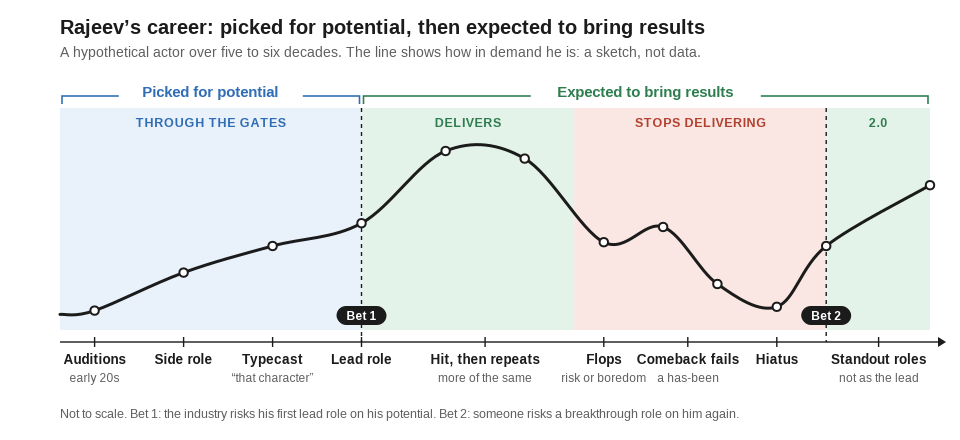
You would agree that once he moved away from his typecast role and was risked as a leading man, that is when the industry decided to take a risk on his potential. And when it paid off, he was expected to continue bringing in the results. This is usually true in almost all careers, especially high-paying, highly ambitious ones. But you will find examples of this in your day-to-day as well.
“You are being asked to lead a project”, or “you are being put in charge of a new division”, or “this new feature is going to be owned end to end by you”, or, even better and simpler to understand, “based on your marks, out of thousands of students, you were among the handful that were selected to interview for this role”.
Those are some of the few examples where the inflection happened for you in your career. If you are a working professional, something similar has already happened to you. If you are a student, this will happen to you. It’s like the nature of any career. Thousands, if not lakhs, want to achieve something (in India, nothing is under lakhs), and each gate is a filter based on potential: minimum cut-off marks for an entrance exam, minimum cut-off marks for a course, minimum cut-offs for jobs, a minimum number of years of experience for a job. They are all gates for “potential checks”.
What I have noticed, coming back to the example of film stars and actors, is this. Let’s talk about others before we talk about ourselves. If you are, like me, a regular moviegoer, you would notice that some actors don’t fit the “leading role”, no matter how much they are given the opportunity. Some go from actors to stars and back to actors. And a lot of stars don’t have the acting chops, yet they still pull in the numbers. You know why? Because they understand the underlying principle of the industry they are in, and they learned to play the game. Most folks think that if they are just a “good actor”, their time will come, and it will automatically make them stars. No doubt they do get recognised for roles, and people may know them. But success usually comes from repeatedly showing results in constrained environments. That’s when people start to expect you to bring in the results.
Why did I pick a film actor as the example? Because the difference is stark here. Magazines, podcasts and media houses almost always run a pseudo-organic campaign of “next big things” every few years. And as and when the person of interest fails to bring in the results, they turn into “has-been” or “is Rajeev dead?” kinds of campaigns. How they work, and why they are pseudo-organic, is not in the scope of this article. But the point is, the film industry is a high-risk, high-reward endeavour. Beyond a certain point, just showing up and doing a good job is not enough. And it is true for the other departments of that industry too: directors, editors, cinematographers. All in all, to sum up this example: the reward concentration is with the top 1% of that industry, and it is by its nature. The subjectivity of the results and the failure rate are too high, so mediocrity is not allowed by design.
So how is such a long detour, a 10,000-ft view of the most coveted industry, gonna help us? Well, we can borrow some ideas from it that have stood the test of time and apply them to our own work.
Get your foot in the door, by hook or by crook
Actors audition. A lot. The goal is volume. The law of large numbers helps. Not just helps: that is the game. Sometimes they try to make friends, or try to get entry to exclusive events. The whole idea is to be seen by the right person. And the crux is, they do it unapologetically. As long as it’s not illegal or immoral, I think that in a scarce world, with even scarcer opportunities, it’s fair game. We already do it too, on a different plane, but the idea is similar: apply to hundreds of jobs, ask for referrals, network at events or gatherings. But do it unapologetically. Don’t think it’s something you can’t do (read about self-efficacy). And don’t be embarrassed that you reached out to a person via an unofficial route. You, and only you, are responsible for your own career. Nobody owes you anything. You need to show that you are worth putting a bet on. Get your foot in the door.
Show potential by repeatedly giving results; try to get recognised for one thing
Actors do multiple auditions. They do multiple roles. With some of the famous actors, if you watch an old film and are a keen observer or a fan, you would notice them somewhere in a cameo. That is expected. Since they are new, nobody knows them. More specifically, nobody knows what they are good at. So, based on availability and need, they do anything and everything under the sun before that one breakout performance. And then they are typecast for that role. We all go through the same journey. Experienced folks who have been working in a job for more than five years could probably relate. We started in one team, then moved to another, then did some other project. And then we are finally known as “that guy who does this well”. And then your role and your work unify. It’s a very interesting and dangerous place to be in. But I say it’s a natural progression of a good career. You need to be good at getting results repeatedly for something. You don’t have to love it, or even be great at it. You just need to understand it enough that you become the obvious choice.
The potential-to-results journey
In the film industry, almost every character actor has done at least one solo lead film. It’s usually a combination of someone betting on you and someone having no leverage left. It’s okay to be the last choice. It’s great to be the first choice. And actors yearn for an opportunity. What we need to take from them is this yearning: the belief that “I want to have a shot at being the next big thing”. For most professionals, it’s about starting a business or a consultancy of their own. I was told that 99 out of 100 self-started businesses fail. Great, so we should not bet on ourselves? If we are not gonna bet on ourselves, then no one will. Sometimes you get lucky: you get a mentor higher up in the company who makes you their protégé. This is very common in good, high-functioning systems built with amazing people who work there because they love the game.
If you go via the excellence route, as I call it (great college → great placement → great at the job), you are more or less bound to find a great mentor almost naturally, in the early years of your career. The way this mostly works is that they see their younger self in you. And that’s great: they help open doors for you that you alone would never be able to open. But what if there is no one like that where you work? Well, like I said, bet on yourself. Become more than your work. Write, publish, learn in public, have a domain under your name (Cloudflare gives great infra and prices for that). Speak, reach out. If you are not visible, then nobody cares. And to be honest, if you ask me, there is no point being there. If nobody finds you, it means you don’t want to be found. And if you don’t want to be found, well, that works, but then I hope you at least had a great time reading this article.
What does the above rambling mean in action? Become high-agency. Try to become a parallel brand of yourself. It could be validated by anything, provided it’s not completely orthogonal to the career you are trying to build your brand in. I find writing about your learnings the best. And trust me, doing enough iterations will get you found. And then the bet can be placed. So bet on yourself, and make people in the industry believe you are good enough to be bet on.
Now, what happens if the bet fails? Keep in mind that results are not just a function of your hard work. If getting results was the only outcome, then half the population that aspires to be something should sit at home. If you have read this far and it doesn’t look obvious (probably because of my shitty writing, which sways more than it stays), then let me make it clear. The underlying theme I am trying to communicate is this:
Be in the game for the love of the game.
It might feel like an anticlimactic result at this stage. But isn’t it obvious? Why would anyone want to spend their whole life doing something they hate, and not get the best out of it either? Then you don’t have a career. You have a job, and you are just one layoff or firing away from being homeless. Truth be told, it’s not very uncommon. When the going gets tough, people just quit. And there is nothing wrong with that. Going back to the actors example: we only covered two classes of actors. Those who were bet on and then delivered, and those who failed and went back to being typecast (sometimes in even worse roles, or for worse pay). When this happens, or even before this, most people just quit. The whole train of thought that I am trying to communicate at this point is this. If you are doing a desk job, and it’s soul-sucking, and it’s not getting any better, then let me tell you this: AI is coming for that job. If you don’t love the game but are simply playing it for the results, very soon you will quit, or worse, get eliminated.
How to get repeated results
Believe it or not, the answer is still the same as how you get typecast: by being good at one thing and repeatedly improving in that domain, so much so that it then improves the domain. I would like to take two real examples for the first time in this article, since I could not think of a better way to communicate this through abstractions anymore.
Shah Rukh Khan and Tom Cruise. They are both popular; most people know both, and almost everyone knows at least one of them. They were both known for making only one thing: romance and action, respectively. Their love of the game and their being good at the craft, combined with their very pleasant on-camera personalities, made them the household names for those two genres of film, both with audiences and in the industry. Whenever they got a success, they always tried to take a risk in their respective genres (they did take risks in different genres too; some worked, some failed). But the whole idea was pushing the boundary of what they could do in that genre, by pushing the genre itself. Shah Rukh Khan did a lot of different types of romance (tragic, comic, horror), making sure his signature stayed a staple so that his audience could recognise it easily. And Tom Cruise just gets younger and crazier with his stunts, to showcase how, even today, something that is real and life-threatening still hooks the audience. They both exhibit the traits we discussed so far.
They are in the game for the love of the game. They are both known for one thing, and for almost always getting results in it. They both make sure they are noticeable through some unique signature (SRK’s arm pose, Tom Cruise’s running). And they both have more or less the same story of how they entered the industry: relative nobodies → did diverse work → got recognised for one performance → became the go-to for those roles → someone took a bet on them → it paid off → pushed themselves, as leading men, in the one thing that worked → redefined the domain.
And the most important part: they have both had their ups and downs, and have had to completely reinvent themselves as per the changing times, in their chosen domain, again and again. They have had more than one comeback (our example hero, Rajeev, had one, and we called it phase 2). They have had n number of phases till now. A string of failures or a long hiatus does not make them demoralised. They just love the game so much that they want to keep playing it, as long as they are allowed to. And they are allowed these comebacks because they are willing to sacrifice something that was a norm for them in their previous phases. The self-belief is so strong that a willing cut to their comfort for a short duration does not deter them. They have not anchored themselves to things apart from what they believe they want to do. And they are willing to go to an extent that no one has gone to before to make it happen. That’s what makes people bet on them repeatedly: their willingness to bet on themselves. Over and over again.
This is what a successful career looks like over a span of decades. Pick any industry, and any person of interest in that industry: this, more or less, was their journey. Can you reach the top if you follow this to a T? Success is a measure of a lot of things, and your role in the results is pretty limited, to be fair. But this flow definitely makes the journey worth it, however long it lasts.
And that is what I would like to leave you with. I opened the discussion by talking about age and its relative mapping to these two concepts: potential and results. I strongly believe this is the only way you can make a career in your domain. Potential is a function of what you think you can do (read about self-efficacy again) versus what the market/world/industry thinks you can do. It’s a very hard, painful process to convince anyone that you have potential, unless you are exceptionally talented. But I think if you love the game enough, to the point that you want to see yourself succeed in that domain/industry/world, you will try everything in your power to make it work. And if you don’t give a shit about your current domain, then maybe it’s time to plan out an exit strategy.
Because if you don’t, the domain will.
Next in thoughts: So many things to do, yet so little time